
The Cost of Perfection
Rethinking the SOS-Free Plant-Based Diet
When the plant-based movement took root, its focus was on flavorful whole plant-based foods that could be easily embraced by people new to the diet. This made sense, because our idea was a new one, needing support. But then over the years, something changed. In the quest for perfection, or what we thought was perfection, many in our community began taking a well-intentioned but increasingly restrictive view of the diet. This view was branded as the “SOS-free diet”—a whole food plant-based diet devoid of all salt, oil, and sugar. It has since become a dominant idea in our community.
Before going further, I want to express a couple of important thoughts. First, I respect the right of each person to make choices that reflect their personal preferences. I always do my best not to judge others who are living with good intentions and expressing their unique individuality. What I share here is offered with humility and without judgment.
I also want to acknowledge that my father and I planted seeds for this SOS-free line of thinking in the early days, when we sometimes spoke about the most natural form of the plant-based diet—what we sometimes defined as optimal—as one consisting of whole foods free of refined ingredients, including oil, salt, and sugar. My dad had focused his research on animal protein—not oil, salt, and sugar—but it seemed sensible to talk about a natural whole food diet this way. With hindsight, I wish we had been more careful in our wording.
I don’t have an issue with the absence of refined oil, aside from minor uses such as lightly seasoning a pan, because oil is not essential to creating delicious plant-based dishes. Some savory and sweet notes, however, are critical to creating appealing flavors. When I speak to audiences about this SOS-free concept, I often encourage people to imagine a plate of brown rice and an assortment of colorful cooked veggies on top. Most people would expect this dish to include some flavorful sauce on top or infused throughout, but if you are on an SOS-free diet, that’s prohibited if the sauce has even a crystal of salt or sugar. Oil is not necessary to create flavor, so there’s no issue leaving that out, but removing sweet and savory notes will deplete this dish of its flavor.
But is it necessary to remove every last crystal of salt and sugar from such a healthy dish? When the SOS-free idea began gaining momentum, I asked my father to review the research on salt to see if he could find any studies showing that a reduction in daily salt intake from a low range of 1200 to 1500 mgs a day to the sodium levels naturally found in plants has any clear evidence of benefit, and he could find none. This was not surprising to him because problems with salt typically occur at significantly higher levels. And the problem most associated with salt—high blood pressure—has many other causes, a principal one being chronic stress. The same story holds true with sugar. No credible research has shown that small amounts of sweeteners, when consumed as part of a healthy whole food plant-based diet, have any harmful effects.
All this being said, it’s important to acknowledge that salt, sugar, and oil can trigger bingeing among people who struggle with overeating. It’s also important, though, to consider what is being triggered. Flavor that makes eating an oil-free, veggie stir-fry joyful is not the same as an excessive combination of salt, sugar and oil triggering someone to binge on an unhealthy processed food. Highly processed foods are harmful, although fortunately, they can be removed from the home, which is likely a more effective solution than taking the radical step of removing flavor from healthy foods. We’ve found that people struggling with overeating who think they must consume bland plant-based foods often fall off the wagon, even if for short bingeing periods. And of course, there are often other issues underpinning the drive to overeat that may require resolution in other ways.
Getting back to the image of the brown rice/veggie stir-fry, I would argue that eating this dish with some flavor is a wholistic idea, whereas the SOS-free approach is reductionist. When we eat this dish, we’re eating a tsunami of health-giving nutrients, more than we can comprehend. These nutrients work in a complex way to maximize the body’s self-healing capacity. The small amount of sugar or salt in this dish cannot undo what this nutrient tsunami creates. With an SOS-free approach, we’re looking past this tsunami and fixating on a meaningless, tiny fraction of the dish. We worry so much about achieving what we believe to be perfect that we force ourselves to eat blander-tasting food. This is a reductionist idea because we are staring at the tree and ignoring the forest.
Again, I respect whatever choices one wants to make about what they eat because I believe in free choice, but while I believe this, I can still say objectively that the trend toward a more extreme version of the plant-based diet has made it inaccessible to many people. When newbies go online to learn more, they see lots of discussion about an SOS-free approach. These newbies then assume this is the way they must eat if they are to reap the benefits of a plant-based diet. Sometimes people still try, but invariably many of them fall off the wagon. Public polling suggests there are at least 10 times as many former vegans as current vegans, and while they fail for many different reasons, we’ve seen from the people who attend our immersion retreats in North Carolina that many quit because they can’t stick to the idea of eating food they perceive as lacking flavor. On the other hand, if you are a person currently eating an SOS-free diet and its working for you, I would never suggest you change anything.
One final thought to share. I believe our way of eating is not only a matter of health, but also a matter of compassion. Eating a plant-based diet is about self-love and sharing it is about loving others. I think we need to keep this in mind as we think through our movement’s messaging.
In my next newsletter, I’ll continue this discussion of messaging, but focusing next on the problem of dietary confusion.
Until then,
Nelson
PS: If you found this helpful, please tap the ❤️ below and share this post with a friend. Your likes and shares help Substack promote our work to new readers.
We also encourage you to consider upgrading to a paid subscription. Paid subscribers receive more in-depth articles and an eBook each month featuring 5-8 new recipes from Kim – and your support will help sustain this publication.
A Plant-Based Party Fondue, by Kim Campbell
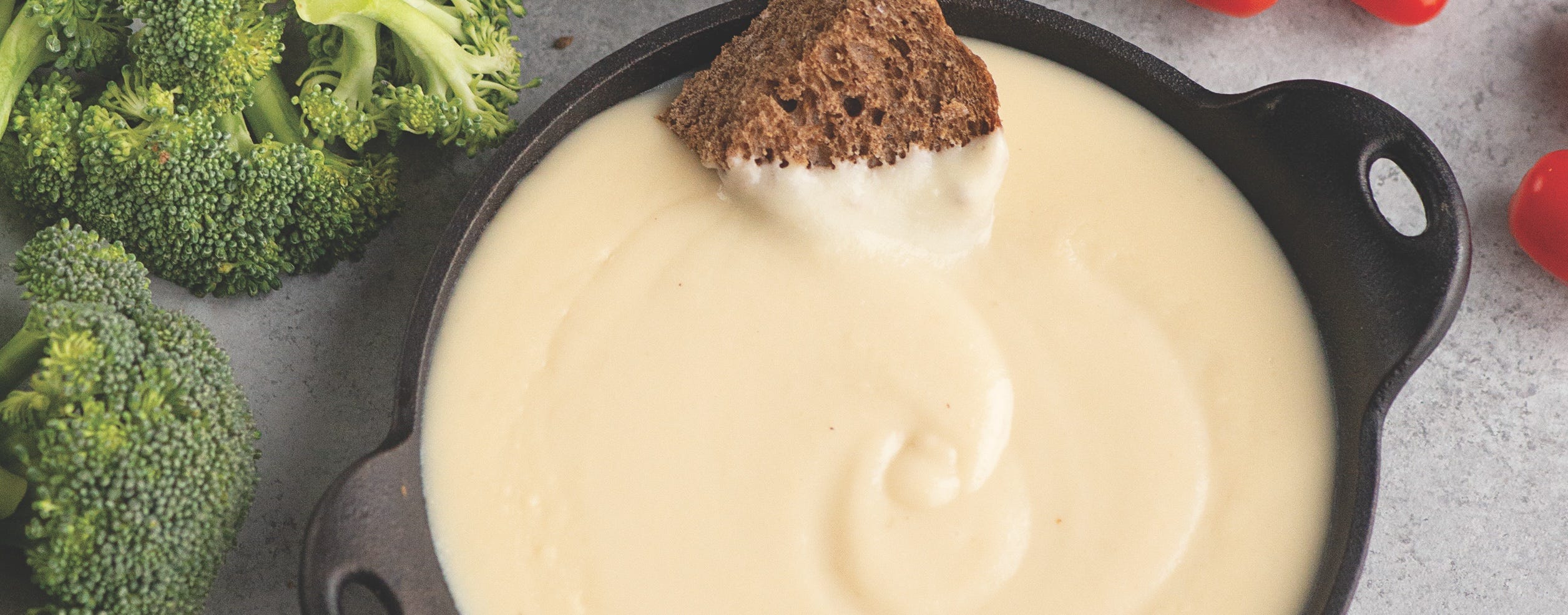
Fondue has been around much longer than our holiday charcuterie boards, which have become very popular as of late. Fondues originated in the Swiss Alps, where winters were long, fresh food was scarce, and people did what any practical household would do: they melted their leftover cheese and dipped stale bread in it. Somehow scarcity turned into comfort. The name comes from the French fondre, meaning “to melt,” and that’s exactly what they did.
By the late 1600s, people around Zurich were writing down recipes for melted cheese mixed with wine and seasonings, and soon everyone had their own special fondue recipe. It became a way to stretch ingredients, warm up a room and gather the household around one pot. Just cheese, bread, conversation, and warmth—to help get through a cold winter together.
While the original fondue concept was built around aged cheeses and wine, I’ve enjoyed creating plant-based versions. This week, I’m sharing a dairy-free cheese fondue that keeps the tradition alive using healthy simple whole-food ingredients.
Whether you’re dipping bread, vegetables, potatoes, or whatever makes you happy, this is food that connects people.
Here is your recipe for a plant-based fondue: https://plantpurecommunities.org/recipes/vegan-party-fondue/
Happy Holidays!
Kim
Well said, Nelson. There seems also to be the other problem, at the extreme as well - there are now so many ultra-processed vegan foods that mimic meat, dairy, eggs, etc., and many people go vegan and eat large amounts of these very unhealthy foods in order to have compassion for animals, etc., and then after 6 months announce on FB that they are miserably sick from vegan food and go back to eating animal-sourced foods. Both extremes are harming our movement.
I’m glad you wrote this. I have tried sos free and didn’t enjoy my food. I only use a little oil when necessary and sweeten with dates or occasionally maple syrup. I eat salt but make everything from scratch. I enjoy my food way more than sos free